
So Your Kid Wants to Try Circus Arts? Here's What Really Happens in Class
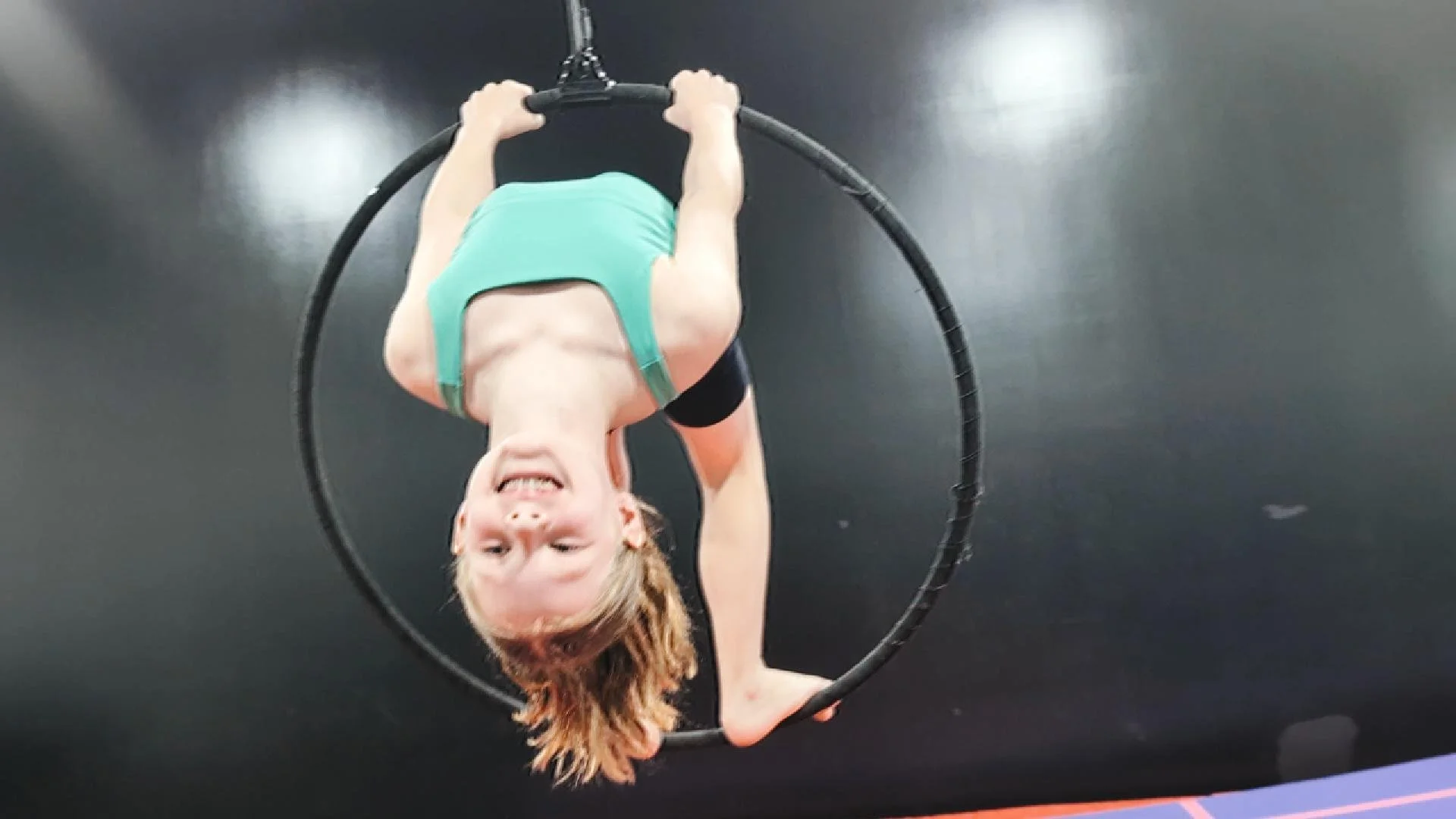
A cirque student having fun on the hoop.
Circus can look intimidating from the outside, apparatus, height, tricks, so it helps to know exactly what a first Cirque class looks like before your child walks in. At Star Performance Academy, our Cirque program is built specifically with beginners in mind, starting as young as age 4 (Junior Kindergarten).
Here's what that actually looks like in the room.
How we keep beginners safe and comfortable
Proper matting under every apparatus. Safety surfacing is standard, not an add-on.
Beginning children always approach apparatus with a teacher alongside them, never on their own.
Small class sizes with dedicated assistants, so no child is working unsupervised or waiting too long for a turn.
A mix of floor-based skills, like juggling and poi, alongside apparatus work, so beginners build skill and coordination for their apperatus too.
Core and fitness fundamentals built in, so kids develop the strength they need to feel steady and capable, not just thrown into tricks.
Every trick is safely progressed from the lowest level up. No child is ever pushed to go higher or attempt something they're not ready for. Progression is always optional, always at the child's own pace.
The syllabus we follow
We teach the Little Cirque & Dance Ciruque Syllabus, an internationally recognized program built specifically for beginner-friendly circus training. It's known for clear, logical skill progressions and a level-based system that lets every child advance at their own speed, with a real sense of achievement built into every stage.
Some studios or parents call this style of class "aerial circus" or "circus arts." At Star, we simply call it Cirque, and it's genuinely designed for first-timers, not just experienced kids looking for a new challenge.
What does the research say about circus arts for kids?
A Canadian study out of Manitoba, comparing Grade 4 and 5 students in circus-enriched physical education against students in standard PE, found circus participation led to significant gains in movement competence, along with real increases in children's confidence, understanding of movement, and willingness to stay active.¹ The researchers also noted circus tends to close the confidence and skill gap between boys and girls more than traditional sport settings, likely because of its inclusive, non-competitive structure.
A separate study comparing kids in circus-arts classes to kids in a standard gym class found the circus group came out ahead on 15 of 18 motor skills, along with a real boost in confidence.² And a 6-month study of a children's circus program found significant improvements across stress relief, self-esteem, confidence, and friendship-building.³
What age can my child start?
Cirque at Star starts at age 4, in Junior Kindergarten. There's no gymnastics, dance, or prior movement background required, just a willingness to try. But older children can start too! That’s the power of the Dance Cirque syllabus.
Try it before committing
If your child is curious but nervous, a free trial class is a low-pressure way to see the room, meet the instructors, and get a feel for the pace before registering.
Sources
Kiez, T.K.M., Kriellaars, D., Cairney, J., Bortoleto, M., Dudley, D., & Aubertin, P. (2019). The Impact of Circus Arts Instruction in Physical Education on the Physical Literacy of Children in Grades 4 and 5. Journal of Teaching in Physical Education, 38(2), 162-169.
Borges-Silva et al. (2018). ScienceDirect.
Kinnunen, R., Lidman, J., Kakko, S-C., & Kekäläinen, K. (2013). "They're smiling from ear to ear": Wellbeing Effects from Social Circus.